


From: http://www.nativeamericans.com/Natives.htm
Languages of North America
The Twentieth Century
The most widely accepted classification of Native American languages N of Mexico (although some included are also spoken in Mexico and Central America) is that made by Edward Sapir in 1929. Sapir arranged the numerous linguistic groups in six major unrelated linguistic stocks, or families. There are Eskimo-Aleut, Algonquian-Wakashan, Nadene, Penutian, Hokan-Siouan, and Aztec-Tanoan.
Aztec-Tanoan
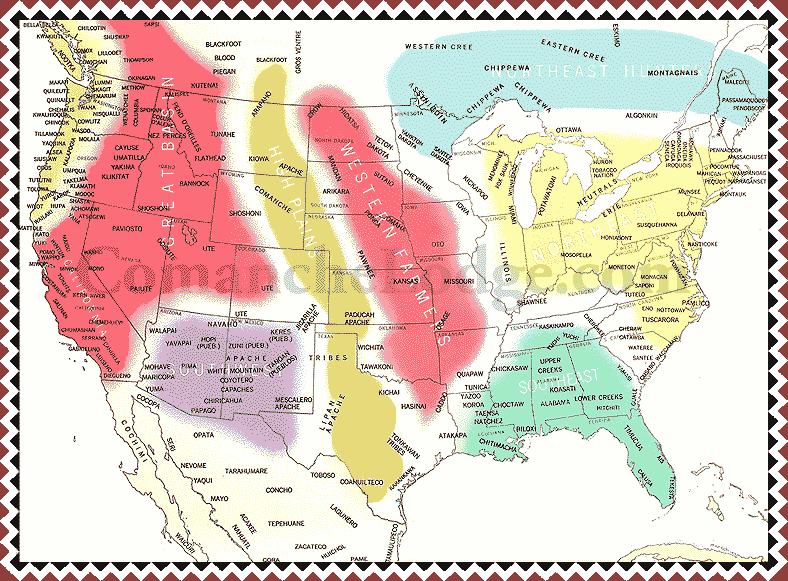
The two principal branches of the Aztec-Tanoan linguistic stock are Uto-Aztecan and Tanoan, and their languages are spoken in areas extending from the NW United States to Mexico and Central America. Uto-Aztecan has such subdivisions, or groups, as Nahuatlan, whose languages are spoken in Mexico and parts of Central America, and Shoshonean, to which Comanche, Hopi, Paiute, Shoshone, and Ute belong. Ute and Paiute are found in Utah, Nevada, California, and Arizona; Comanche and Shoshone are spoken in Wyoming, Nevada, Utah, California, and Oklahoma; Hopi is found in Arizona. The languages of the Tanoan branch of Aztec-Tanoan are spoken in the Rio Grande valley, New Mexico, and Arizona. Zui (found in New Mexico) may be connected with Tanoan. The Aztec-Tanoan languages show a degree of polysynthesism.
The Twentieth Century
The most widely accepted classification of Native American languages N of Mexico (although some included are also spoken in Mexico and Central America) is that made by Edward Sapir in 1929. Sapir arranged the numerous linguistic groups in six major unrelated linguistic stocks, or families. There are Eskimo-Aleut, Algonquian-Wakashan, Nadene, Penutian, Hokan-Siouan, and Aztec-Tanoan.
Aztec-Tanoan
The two principal branches of the Aztec-Tanoan linguistic stock are Uto-Aztecan and Tanoan, and their languages are spoken in areas extending from the NW United States to Mexico and Central America. Uto-Aztecan has such subdivisions, or groups, as Nahuatlan, whose languages are spoken in Mexico and parts of Central America, and Shoshonean, to which Comanche, Hopi, Paiute, Shoshone, and Ute belong. Ute and Paiute are found in Utah, Nevada, California, and Arizona; Comanche and Shoshone are spoken in Wyoming, Nevada, Utah, California, and Oklahoma; Hopi is found in Arizona. The languages of the Tanoan branch of Aztec-Tanoan are spoken in the Rio Grande valley, New Mexico, and Arizona. Zui (found in New Mexico) may be connected with Tanoan. The Aztec-Tanoan languages show a degree of polysynthesism.
The mere fact that one of the branches of language is called Aztec-Tanoan and spoken by tribes in the southwest United States is not mere coincidence. These languages are spoken by the Zuni and Hopi tribes, ancestors of the Pueblo Indians who are primarily in Arizona and New Mexico.
Seems difficult to say that Mexicans are not related to Native-American tribes or that they did not inhabit any portion along the southwest.


