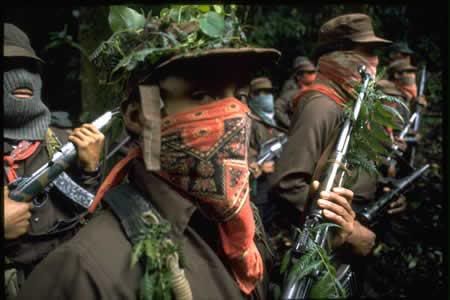
The Zapatista Army of National Liberation (Ejército Zapatista de Liberación Nacional, EZLN) is an armed revolutionary group based in Chiapas, one of the poorest states of Mexico. Their social base is mostly indigenous but they have supporters in urban areas as well as an international web of support. Their most visible voice, although not their leader, is Subcomandante Marcos (currently a.k.a. Delegate Zero in relation to the "Other Campaign"). Unlike the Zapatista comandantes, Subcomandante Marcos is not an indigenous Mayan.
Some consider the Zapatista movement the first "post-modern" revolution: an armed, yet non-violent (despite an uprising in the early 1990s) revolutionary group that incorporates modern technologies like satellite telephones and the internet as a way to obtain domestic and foreign support. They consider themselves part of the wider anti-globalization, anti-neoliberalism movement.
Brief history
The Zapatistas went public in 1994 with the initial goal of overthrowing the Mexican government. Short armed clashes in Chiapas ended on January 12 of that year with the declaration of a unilateral ceasefire by the EZLN, and there have been no full-scale confrontations since. The Mexican government instead pursued a policy of low-intensity warfare with para-military groups in an attempt to control the rebellion, while the Zapatistas developed a mobilization and media campaign through numerous newspaper comunicados and over time a set of six "Declarations of the Lacandonian Jungle," with no further military actions on their part. A strong international Internet presence has prompted the adherence to the movement of numerous leftist international groups.
The Intercontinental Encounters for Humanity and against Neoliberalism, an international conference in the Chiapas, hosted by the Zapatistas in 1994, resulted in various other Zapatista groups emerging outside of Mexico, including the West Essex Zapatista in East London.
Government talks with the EZLN culminated in the San Andrés Accords (1996) that granted autonomy and special rights to the indigenous population. President Zedillo and the Institutional Revolutionary Party (PRI) however, ignored the agreements and instead increased military presence in the region. With the new government of President Fox the Zapatistas marched in 2001 towards Mexico City to present their case to the Mexican Congress. Watered-down agreements were rejected by the rebels who proceeded to create 32 autonomous municipalities in Chiapas, thus partially implementing the agreements without government support but with some funding from international organizations.
In July 2005 the Zapatistas presented the Sixth Declaration of the Lacandon Jungle. In this new Declaration, the EZLN called for an alternative national campaign (the "Other Campaign") in opposition to the current presidential campaign. In preparation for this alternative campaign, the Zapatistas invited to their territory over 600 national leftist organizations, indigenous groups and non-governmental organizations in order to listen to their claims for human rights in a series of biweekly meetings that culminated in a plenary meeting in September 16, the day Mexico celebrates its independence from Spain. In this meeting, Subcomandante Marcos requested official adherence of the organizations to the Sixth Declaration, and detailed a 6 month tour of the Zapatistas through all 31 Mexican states that is taking place concurrently with the electoral campaign starting January 2006.
Detailed History
The group was founded on November 17, 1983 by former members of different groups, both pacifist and violent. They broke onto the national and international scene on January 1, 1994, the same day that the North American Free Trade Agreement between Mexico, the United States and Canada became operational, as a way of stating the presence of indigenous peoples in the middle of a globalized world.
Indigenous fighters wearing the black ski masks (pasamontañas) or red bandanas (paleacates) that later became the group's trademark, some of them armed only with fake wooden rifles, took hold of five municipalities in Chiapas. There were token resistance in 4 of those and dozens of casualties in and around the city of Ocosingo. The Zapatistas officially declared war against the Mexican government, and announced their plans to march towards Mexico City, the capital of Mexico, either defeating the Mexican army or allowing it to surrender and imposing a war tax on the cities that they conquered in their way.
Unusual for any revolutionary organisation, documents released by the EZLN [1] (In Spanish) before the uprising defined a right of the people to resist any unjust actions of the EZLN. They also defined a right of the people to:
"demand that the revolutionary armed forces not intervene in matters of civil order or the disposition of capital relating to agriculture, commerce, finances, and industry, as these are the exclusive domain of the civil authorities, elected freely and democratically." And said that the people should "acquire and possess arms to defend their persons, families and property, according to the laws of disposition of capital of farms, commerce, finance and industry, against the armed attacks committed by the revolutionary forces or those of the government."
This sign reads, in Spanish: Top sign: "You are in Zapatista rebel territory. Here the people give the orders and the government obeys." Bottom sign: "North Zone. Council of Good Government. Trafficking in weapons, planting, drug use, intoxicating beverages, and illegal sales of wood are strictly prohibited. No to the destruction of nature." Federal Highway 307, Chiapas.
After just a few days of localized fighting in the jungle, President Carlos Salinas de Gortari, then in his last year in office, offered a cease-fire agreement and opened dialog with the rebels, whose official spokesperson was Subcomandante Marcos. After twelve days, the fighting stopped.
The dialogue between the Zapatistas and the government extended over a period of three years and ended with the San Andrés Accords, which entailed modifying the national constitution in order to grant special rights, including autonomy, to indigenous people. A commission of deputies from political parties, called COCOPA, modified slightly the agreements with the acceptance of the EZLN. The new President of Mexico, Ernesto Zedillo, however, said Congress would have to decide whether to pass it or not. Claiming a violation of promises at the negotiating table, the EZLN went back into the jungle while Zedillo increased the military presence in Chiapas to prevent the spread of EZLN's influence zone. An unofficial truce accompanied by EZLN's silence ensued for the next three years, the last in Zedillo's term.
After the dialogue ended, many accusations were made against the Mexican army and para-military groups due to prosecution, detentions and killings of Zapatistas and supporters; one particular incident was the Massacre of Acteal, where 45 people attending a church service were killed by unknown persons. The motives and the identities of the attackers aren't clear, to the point it might not be related to the EZLN at all (however, the survivors claim that they were attacked by paramilitaries).
In 2000 President Vicente Fox Quesada, the first from the opposition in 72 years, sent the so-called COCOPA Law (constitutional changes) to Congress on one of his first acts of government (December 5, 2000), as he had promised during his campaign. After seeing the criticism and proposed modifications by notable congressmen, Subcomandante Marcos and part of his group decided to go, unarmed, to Mexico City in order to speak at congress in support of the original proposal. After a march through seven Mexican states with substantial support from the population and media coverage (and escorted by police to protect the EZLN members), representatives of the EZLN (not including Marcos) spoke at Congress in March, 2001, in a controversial event. The march was nicknamed "Zapatour", and on the day of their arrival an unrelated concert for peace was held. During their stay they visited schools and universities.
Soon after the EZLN had returned to Chiapas, Congress approved a different version of the COCOPA Law, which did not include the autonomy clauses, claiming they were in contradiction with some constitutional rights (including private property and secret voting); this and other changes were seen as a betrayal by the EZLN and other political groups. These constitutional changes still had to be approved by a majority of state congresses. Many political and ethnic groups filed complaints both against and in favour of the changes, which were finally approved and went into effect on August 14, 2001. This, and the still recent President Fox's electoral victory in 2000 slowed down the movement, which had less media coverage since then.
As a last recourse to void the changes, a constitutionality complaint was filed to be resolved by the Supreme Court of Justice, which ruled in September 6, 2002 that since they were constitutional changes made by Congress and not a law as it was wrongly called, it was outside its power to reverse the changes, as that would be an invasion of Congress' sovereignty.
Until 2004 many people believed Marcos had fled from Chiapas. Attempts to contact him failed or were answered by email or Internet publications. Although Marcos has denied to be the head of the Zapatista movement, presenting himself as a spokesman, he is by far the most prominent figure of the EZLN to the public. There are 23 commanders and 1 subcommander which total 24, the collective leadership of the EZLN, one of its unique characteristics, known as the Comité Clandestino Revolucionario Indígena or CCRI, Revolutionary Indigenous Clandestine Committee).
The communiques of 2004 list accomplishments and failures of their movement. From their own point of view, the Councils of Good Government, or Juntas de Buen Gobierno have been successful, as well as efforts to keep the violence between them and the military to a minimum. Their efforts to increase the role of women in cultural and political matters were not as successful.
From these communiqués it seems Marcos has been following the developments, from wherever he was. He also reiterated their long known opposition to what they see as a worldwide movement towards a neoliberal globalized economy, claiming that the current trend in government policies disempowers the people and establishes a de facto corporate government. The United States war on terror, IMF/World Bank sponsored economic policies, and free trade agreements are seen as an application of these policies.
In October 2004, Subcomandante Marcos issued communiques explaining the problems that the EZLN had with the Mexican government. Some Zapatista communities were expelled from their homes. The EZLN claims that this is an attempt to gain control of an area rich in natural resources (biodiversity and oil). These communities were relocated with great difficulty due to lack of resources, something that the EZLN intended to alleviate by calling for international help. The Mexican government maintains a vague stance on the issue, claiming the people were moved for their own benefit.
However, the relevance of the EZLN to the national political agenda diminished. The Zapatistas claim that this silent period of their uprising has been an extremely rich effort, centered in organizing their own "good government" and lives autonomously; in particular the organization for an autonomous education and healthcare system, with its own schools, hospitals and pharmacies in places neglected by the Mexican government. Recently, with the Sixth Declaration of the Lacandon jungle it seems that the Zapatistas will again enter into the political arena.
There are currently 32 "rebel autonomous zapatista municipalities" (independent Zapatista communities, MAREZ from their name in Spanish) in Chiapas.