Cryptozoology

  • Wanna Join? New users you can now register lightning fast using your Facebook or Twitter accounts.
Dec 8, 2005
669
0
36
#41
ThaG said:
I am just as curious about the other 99% as you are
money money money. theres not a lot of money in this shit. persoanlly id rather my money be spent on nasa and deep sea research than trying to feed starving children and rebuilding cities we just got done bombing. some will read this and say whoa whoa buddy, thats selfish. but im coming from the point that the potential benefits of this type of research will allow 1000x more people to flourish than sending food only to be intercepted by millitias and sold anyway.

and lets not forget its a religious world my friend. these people motivations are different from mine, they think earth is the center of gods creation, fuck space,they are all going to heaven to lay under palm trees with jesus, what the fuck do they really give about the long term survival of future generations. but anyway...alotta people know this and its kinda old, but heres a former crypto species that isnt crypto anymore....


Giant Squid
http://news.bbc.co.uk/2/hi/sci/tech/4288772.stm
 
Aug 6, 2006
2,010
0
0
40
#42
Hobbits? We've got a cave full

By Deborah Smith, Science Editor, Fairfax Digital
December 6, 2004


"Chief Epiradus Dhoi Lewa has a strange tale to tell. Sitting in his bamboo and wooden home at the foot of an active volcano on the remote Indonesian island of Flores, he recalls how people from his village were able to capture a tiny woman with long, pendulous breasts three weeks ago.

'They said she was very little and very pretty,' he says, holding his hand at waist height. 'Some people saw her very close up.'

The villagers of Boawae believe the strange woman came down from a cave on the steaming mountain where short, hairy people they call Ebu Gogo lived long ago.

'Maybe some Ebu Gogo are still there,' the 70-year-old chief told the Herald through an interpreter in Boawae last week.

The locals' descriptions of Ebu Gogo as about a metre tall, with pot bellies and long arms match the features of a new species of human 'hobbits' whose bones were recently unearthed by Australian and Indonesian researchers in a different part of Flores in a cave known as Liang Bua.

The unexpected discovery of this tiny Homo floresiensis, who existed until at least 12,000 years ago at Liang Bua, before being apparently wiped out by a volcanic eruption, was hailed as one of the most important archaeological finds in decades when it was announced in October.

The chief adds that the mysterious little woman in Boawae somehow 'escaped' her captors, and the local police said they knew nothing of her existence when he quizzed them.

The prospect that some hobbits still exist in pockets of thick, fertile jungle on Flores is extremely unlikely, says Douglas Hobbs, a member of the team that discovered Homo floresiensis. But it is possible they survived near Boawae until 300 or so years ago, when the chief's ancestors moved into the area, he says.

The detailed stories that the villagers tell about the legendary Ebu Gogo on the volcano have convinced the Australian and Indonesian team to search for bones of hobbits in this cave when they return to the rugged island next year, says Hobbs, an emeritus archaeologist with the University of New England, who discussed excavation plans with the chief last week.

Getting to the cave on the 2100-metre-high Ebulobo volcano, however, will be no simple matter for the team led by Professor Mike Morwood of UNE. The blood of a pig must first be spilt in this society where Catholic faith is melded with animist beliefs and ancestor worship.

The sacrifice and the feast will please the ancestors and bring many villagers together to talk about the cave, says the chief, whose picture of his grandfather, the king, in traditional head-dress, sits framed on the wall next to images of Jesus.
Grandfather of Chief Epiradus Dhoi Lewa of Boawae.


Grandfather of Chief Epiradus Dhoi Lewa of Boawae.

If the right rituals are followed, 'then we will be able to find the road to the hole again', he says.

A Dutch palaeontologist, Dr Gert van den Bergh, a member of the team, was first shown the cave at a distance more than a decade ago, after hearing folk tales of the Ebu Gogo, which means 'grandmother who eats everything'.

People living around the volcano told him a consistent story of the hairy creatures that devoured whatever they could grasp in their long fingers. The villagers tolerated the stealing of food until the Ebu Gogo began to snatch babies and eat them too. They then set upon the little people, forcing them out of the cave with bales of burning grass.

Van den Bergh dismissed the tales as akin to those of leprechauns and elves, until the hobbit bones were found.

While the search for more bones is being planned, a political furore has broken out after a leading Indonesian palaeoanthropologist - with no connection to the find - last week 'borrowed' all the delicate remains from six hobbits found at Liang Bua against the wishes of local and Australian team members. Professor Teuku Jacob, of Gadjah Mada University, who has challenged the view that Homo floresiensis is a new species, had previously taken the skull and bones of the most complete specimen, a 30-year-old female hobbit, from the Indonesian Centre for Archaeology in Jakarta, where they had been kept.

Professor Morwood said it was wrong that the team who found the remains were unable to analyse them first. 'It is not good for the Indonesian researchers nor their institution.'

However, he said Professor Jacob had signed an agreement to return all the bones by January 1."

Also see:
Hobbit-Like Human Ancestor Found in Asia
http://news.nationalgeographic.com/news/2004/10/1027_041027_homo_floresiensis.html

Miniature People Add Extra Pieces to Evolutionary Puzzle

http://www.nytimes.com/2004/11/09/s...00&en=a30132a347d46285&ei=5088&partner=rssnyt

 
Dec 8, 2005
669
0
36
#43
follow up to my last post

Giant squid lights up for attack
By Rebecca Morelle
Science reporter, BBC News
http://news.bbc.co.uk/2/hi/science/nature/6357005.stm


The squid wasn't as sluggish as was first thought


The squid in action
Enormous deep-sea squid emit blinding flashes of light as they attack their prey, research shows.

Taningia danae's spectacular light show was revealed in video footage taken in deep waters off Chichijima Island in the North Pacific.

Japanese scientists believe the creatures use the bright flashes to disorientate potential victims.

Writing in a Royal Society journal, they say the squid are far from the sluggish, inactive beasts once thought.

In fact, the footage, taken in 2005 - the first time T. danae had been captured on camera in their natural environment - reveals them to be aggressive predators.

The squid, which can measure over 2m (7ft) in length, deftly swim backwards and forwards by flapping their large, muscular fins. They are able to alter their direction rapidly by bending their flexible bodies.

The films, taken at depths of 240m to 940m (790 to 3,080ft), also show the cephalopods reaching speeds of up to 2.5m (8ft) per second as they attack the bait, capturing it with their eight tentacles.

Blinding flashes

However, the intense pulses of light that accompanied the ferocious attacks surprised the research team.

Dr Tsunemi Kubodera from the National Science Museum in Tokyo, who led the research, told the BBC News website: "No-one had ever seen such bioluminescence behaviour during hunting of deep-sea large squid."

The footage reveals the creatures emitting short flashes from light-producing organs, called photophores, on their arms.


See how the squid launches its dazzling attack


More details


Writing in Proceedings of the Royal Society B, the team said: "[The bioluminescence] might act as a blinding flash for prey."

The light would disorientate the squid's intended prey, disrupting their defences, they added.

It could also act, the scientists commented, "as a means of illumination and measuring target distance in an otherwise dark environment."

However, further investigation revealed the light bursts may also serve another, quite different, purpose away from the hunting field - courtship.

As the squid drifted around torches that had been attached to the bait rig, they emanated long and short pulses of light.

The team believe the torch lights may have resembled another glowing T. danae, and the squid were possibly emitting light as courtship behaviour.

Difficult subjects

SIZE COMPARISON


Deep-sea squid - once thought to be legendary monsters of the sea - are notoriously difficult to study, and little is known about their ecology and biology. Several species prowl the ocean depths.

T. danae is thought to be abundant in the tropical and subtropical oceans of the world. The largest reported measured 2.3m (7.5ft) in length and weighed nearly 61.4kg (134.5lbs).

Larger species of giant squid belong to the Architeuthidae family: females are thought to measure up to 13m (43ft) in length.

But the aptly named colossal squid (Mesonychoteuthis hamiltoni) is thought to be the largest of all - possibly reaching up to 14m (46ft) long.
 
Aug 6, 2006
2,010
0
0
40
#44
Top Ten Cryptozoo Mystery Pix 2006


1


What mystery fish or whatever is shown on this antique postcard produced between 1904-18?


2.


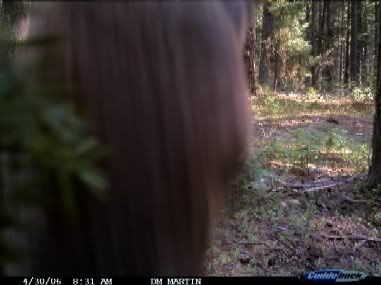
What did researchers Klindt’s & Dianna’s remote cam catch on April 30, 2006, near Mt. Hood, Oregon, USA?


3.


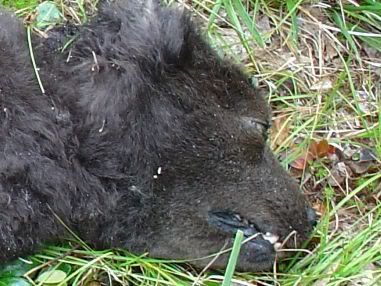
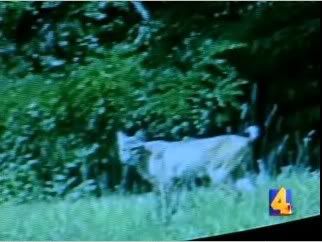
What was the "Maine Mutant" photographed by Michelle O’Donnell in Turner, Maine, in August 2006? (This one turned out to be 100% dog.)

Images #1, #2, and #3 may be clicked on to make them larger.

4.


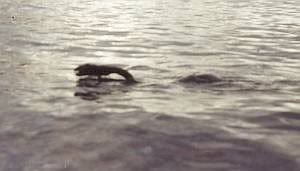
Was this new photo taken around August 15, 2006, at Lake Nahuel Huap, really the famed Argentinan Lake Monster, Nahuelito?

5.


What are we to make of this photo of a mystery carving of an alleged Stegosaurus stenops on an ancient Cambodian temple at Angkor Wat? (See more photos of this, including close-ups, here.)
http://www.cryptomundo.com/cryptozoo-news/dino-cambodia/


6.


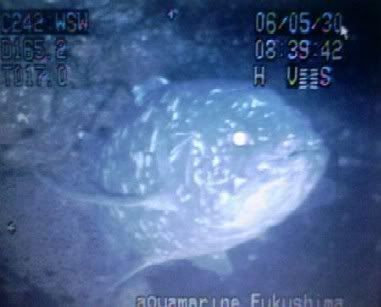
How would you feel if you had filmed the first live Indonesian coelacanth underwater, as a Japanese team did at the depth of 170 m, 17, at 8:30 am on May 30, 2006, off shore Buol, about 350 km west from Manado, Sulawesi Island?

7.


Mystery tracks showing up in Johor, beginning in January, 2006, still beg the question: Were they from a Malaysian Bigfoot, rhino, elephant, or something else?

8


Nothing is there, and then something is there, in October 2006, right? What was the long thing on the bottom of Loch Ness that is seen near the rocks?

9.


In mid-November 2006, was it an American bobcat, Canadian lynx, Eurasian lynx or African Caracal being seen in Warner Park, Nashville, Tennesseee?

10.


Why was a giant squid in a Japanese parking lot in July 2006?
 
Sep 25, 2005
1,148
1,075
0
45
#45
Modern Sightings

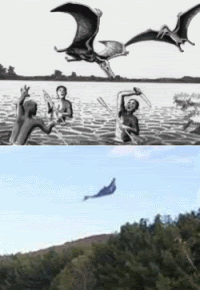
Although there seems to be no hard evidence that pterosaurs did not die out millions of years ago - no pterosaurs have ever been captured and no bodies have ever been found - sightings have persisted. Stories of flying reptiles have been recorded for many hundreds of years. Some think that tales of the "mythical" dragons in the lore of many cultures around the would could be attributed to the sighting of pterosaurs. Here are some more modern accounts:

May, 1961, New York State - A businessman flying his private plane over the Hudson River Valley claimed that he was "buzzed" by a large flying creature that he said "looked more like a pterodactyl out of the prehistoric ages."

Early 1960s, California - A couple driving through Trinity National Forest reported seeing the silhouette of a giant "bird" that they estimated to have a wingspan of 14 feet. They later described it as resembling a pterodactyl.

January, 1976, Harlingen, Texas - Jackie Davis (14) and Tracey Lawson (11) reported seeing a "bird" on the ground that stood five feet tall, was dark in color with a bald head and a face like a gorilla's with a sharp, six-inch-long beak. A subsequent investigation by their parents uncovered tracks that had three toes and were eight inches across.

February, 1976, San Antonio, Texas - Three elementary school teachers saw what they described as a pterodactyl swooping low over their cars as they drove. They said its wingspan was between 15 and 20 feet. One of the teachers commented that it glided through the air on huge, bony wings - like a bat's.

September, 1982, Los Fresnos, Texas - An ambulance driver named James Thompson was stopped while driving on Highway 100 by his sighting of a "large birdlike object" flying low over the area. He described it as black or grayish with a rough texture, but no feathers. It had a five- to six-foot wingspan, a hump on the back of its head, and almost no neck at all. After consulting some books to identify the creature, he decided it most looked like a pterosaur.

Africa's Kongamato

While other reports of pterosaur-like creatures have come out of Arizona, Mexico and Crete, it is out of central Africa that some of the most interesting anecdotes have come. While traveling though Zambia in 1923, Frank H. Melland collected reports from natives of an aggressive flying reptile they called kongamoto, which means "overwhelmer of boats." The natives, who were occasionally tormented by these creatures, described them as being featherless with smooth skin, having a beak full of teeth and a wingspan of between four and seven feet. When shown illustrations of pterosaurs, Melland reported, "every native present immediately and unhesitatingly picked out and identified it as a kongamato."

In 1925, a native man was allegedly attacked by a creature that he identified as a pterosaur. This occurred near a swamp in Rhodesia (now Zambia) where the man suffered a large wound in his chest that he said was caused by the monster's long beak.

In the late 1980s, noted cryptozoologist Roy Mackal led an expedition into Namibia from which he had heard reports of a prehistoric-looking creature with a wingspan of up to 30 feet.
 

Y-S

Sicc OG
Dec 10, 2005
3,765
0
0
#47
Isle of demons?


Blaeu map, 1617

The Isles of Demons are found in the Newfoundland/Labrador region. They are generally shown as two islands. One of the earliest appearances was on a Ruysch map of 1507, and they became more widely known when they appeared on maps by Mercator and Ortelius in the 1560's and 1570's. These islands disappeared from maps by the mid-1600's. There are no islands off the Newfoundland coast as pictured above.

The island was believed to be full of monsters, wild animals, and demons whose sole purpose was to torment and attack passing ships and anyone foolish to go onto the island. Strange noises could be heard on this island as ships passed by. One story, by Andre Thevet, tells of a French woman in the 1540's who was on board a ship of colonists and fell in love with an officer on the ship, and was banished to the island . She, the officer, and an old nurse were tormented by the demons and wild animals. Eventually, the woman was rescued by a passing ship, but the other two had died. Read more of this story, from the Heptameron of Margaret, Queen of Navarre. Look for Chapter 67 ( LXVII)

http://204.200.204.253/myth/Places/isles_of_demons.htm
 
Aug 6, 2006
2,010
0
0
40
#48
^^Good one.. I believe that all stories have at least some element of truth to it.. A "beast" or "monster" can simply be a carnivorous animal that the observers haven't seen before....