


Snubnoze said:
Tell me how ancient sea creature fossils are found in mountains that contain rock that is created in the ocean. Does this change in the earth's formation happen in 6000 years? How is carbon dating inacurate? How can you with a straight face say that the earth is only 6000 years old considering a rediculous amount of evidence saying otherwise...
I don't understand how people can throw out facts and evidence just because its not in the bible. Evolution is KNOWN and ACCEPTED by scientist and people who dedicate their life to study the origin of man, or other species for that matter. With all the evidence out there that is accessible I don't understand how anybody can call it bullshit. But then again, these are typically the same type of people who believe earthquakes are caused by God :dead: ...
I don't understand how people can throw out facts and evidence just because its not in the bible. Evolution is KNOWN and ACCEPTED by scientist and people who dedicate their life to study the origin of man, or other species for that matter. With all the evidence out there that is accessible I don't understand how anybody can call it bullshit. But then again, these are typically the same type of people who believe earthquakes are caused by God :dead: ...
exactly!
peep this site: http://www.oceansofkansas.com/
I did a little research on Kansas and the Ocean fossils found in here....one of the furthest places from any Ocean in North America...
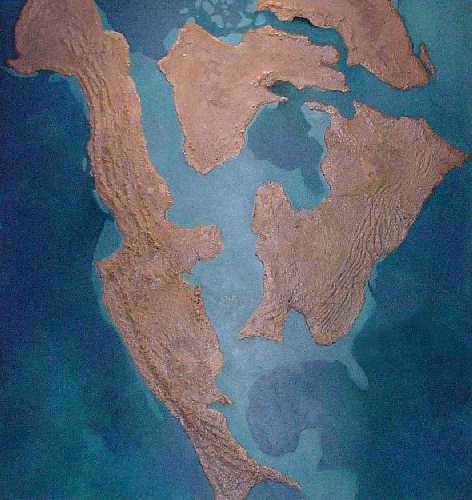
The Cretaceous Period lasted from about 144 million years ago to 65 million years ago. In Kansas, it is represented by marine and estuarine deposits from the Early Cretaceous (Albian) Cheyenne Sandstone and Kiowa Shale that overlay the Wellington Formation (Permian) or the Morrison Formation (Jurassic) at the base, to the Pierre Shale at the top. (See Kansas Geology Map and Time Scale). A brief Cretaceous Time Scale is found here. The 1999 version of the GSA (Geological Society of America) geologic time scale is found HERE as a printable .pdf file (233 kb).
A major part of the upper portion (Late Cretaceous) of these deposits is referred to as the Niobrara Formation. It contains a rather unique member called the Smoky Hill Chalk, and provides the exposures for two Kansas landmarks: Castle Rock and Monument Rocks. The chalk found in Kansas was deposited between 87 and 82 million years ago during a period when a shallow inland sea (the Western Interior Sea) covered most of the Midwest from the Gulf of Mexico to the Arctic Circle. The deposition of these chalky, marine sediments occurred during the last half of the Cretaceous Period, approximately 15-20 million years before the end of the Age of Dinosaurs.
The Smoky Hill Chalk member is about 600 feet thick in Kansas, and lies conformably above the Fort Hays Limestone, and below the Pierre Shale. For the most part, the chalk is composed of the compacted shells (coccolithophores) and plates (coccoliths) of an abundant, microscopic, golden-brown algae (Chrysophyceae) that lived in the clear waters of a warm, shallow sea. A large percentage of the chalk is made up of coprolites containing coccoliths from the animals that fed on the algae.

