


http://news.bbc.co.uk/1/hi/world/africa/1068950.stm
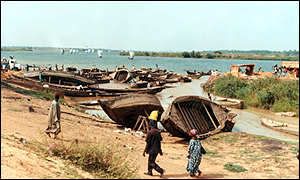
Abubakari gave up his kingdom to pursue knowledge
By Joan Baxter in Mali
An African emperor who ruled Mali in the 14th century discovered America nearly 200 years before Christopher Columbus, according to a book to be launched this month.
Abubakari II ruled what was arguably the richest and largest empire on earth - covering nearly all of West Africa.
According to a Malian scholar, Gaoussou Diawara in his book, 'The Saga of Abubakari II...he left with 2000 boats', the emperor gave up all power and gold to pursue knowledge and discovery.
Abubakari's ambition was to explore whether the Atlantic Ocean - like the great River Niger that swept through Mali - had another 'bank'.
In 1311, he handed the throne over to his brother, Kankou Moussa, and set off on an expedition into the unknown.
His predecessor and uncle, Soundjata Keita, had already founded the Mali empire and conquered a good stretch of the Sahara Desert and the great forests along the West African coast.
Gold fields
The book also focuses on a research project being carried out in Mali tracing Abubakari's journeys.
"We are not saying that Abubakari II was the first ever to cross the ocean," says Tiemoko Konate, who heads the project
"There is evidence that the Vikings were in America long before him, as well as the Chinese," he said.
The researchers claim that Abubakari's fleet of pirogues, loaded with men and women, livestock, food and drinking water, departed from what is the coast of present-day Gambia.
They are gathering evidence that in 1312 Abubakari II landed on the coast of Brazil in the place known today as Recife.
"Its other name is Purnanbuco, which we believe is an aberration of the Mande name for the rich gold fields that accounted for much of the wealth of the Mali Empire, Boure Bambouk."
Another researcher, Khadidjah Djire says they have found written accounts of Abubakari's expedition in Egypt, in a book written by Al Omari in the 14th century.
"Our aim is to bring out hidden parts of history", she says.
Black traders
Mr Konate says they are also examining reports by Columbus, himself, who said he found black traders already present in the Americas.
They also cite chemical analyses of the gold tips that Columbus found on spears in the Americas, which show that the gold probably came from West Africa.
But the scholars say the best sources of information on Abubakari II are Griots - the original historians in Africa.
Mr Diawara says the paradox of Abubakari II, is that the Griots themselves imposed a seal of silence on the story.
"The Griots found his abdication a shameful act, not worthy of praise," Mr Diawara said.
"For that reason they have refused to sing praise or talk of this great African man."
Mr Diawara says the Griots in West Africa such as Sadio Diabate, are slowly starting to divulge the secrets on Abubakari II.
'Hard-nosed historians'
But the research team says an even bigger challenge is to convince hard-nosed historians elsewhere that oral history can be just as accurate as written records.
Mr Diawara believes Abubakari's saga has an important moral lesson for leaders of small nation states in West Africa, which were once part of the vast Mande-speaking empire.
"Look at what's going on in all the remnants of that empire, in Ivory Coast, Sierra Leone, Liberia, Guinea.
"Politicians are bathing their countries in blood, setting them on fire just so that they can cling to power," says Mr Diawara.
"They should take an example from Abubakari II. He was a far more powerful man than any of them. And he was willing to give it all up in the name of science and discovery."
"That should be a lesson for everyone in Africa today," concludes Mr Diawara.
Abubakari gave up his kingdom to pursue knowledge
By Joan Baxter in Mali
An African emperor who ruled Mali in the 14th century discovered America nearly 200 years before Christopher Columbus, according to a book to be launched this month.
Abubakari II ruled what was arguably the richest and largest empire on earth - covering nearly all of West Africa.
According to a Malian scholar, Gaoussou Diawara in his book, 'The Saga of Abubakari II...he left with 2000 boats', the emperor gave up all power and gold to pursue knowledge and discovery.
Abubakari's ambition was to explore whether the Atlantic Ocean - like the great River Niger that swept through Mali - had another 'bank'.
In 1311, he handed the throne over to his brother, Kankou Moussa, and set off on an expedition into the unknown.
His predecessor and uncle, Soundjata Keita, had already founded the Mali empire and conquered a good stretch of the Sahara Desert and the great forests along the West African coast.
Gold fields
The book also focuses on a research project being carried out in Mali tracing Abubakari's journeys.
"We are not saying that Abubakari II was the first ever to cross the ocean," says Tiemoko Konate, who heads the project
"There is evidence that the Vikings were in America long before him, as well as the Chinese," he said.
The researchers claim that Abubakari's fleet of pirogues, loaded with men and women, livestock, food and drinking water, departed from what is the coast of present-day Gambia.
They are gathering evidence that in 1312 Abubakari II landed on the coast of Brazil in the place known today as Recife.
"Its other name is Purnanbuco, which we believe is an aberration of the Mande name for the rich gold fields that accounted for much of the wealth of the Mali Empire, Boure Bambouk."
Another researcher, Khadidjah Djire says they have found written accounts of Abubakari's expedition in Egypt, in a book written by Al Omari in the 14th century.
"Our aim is to bring out hidden parts of history", she says.
Black traders
Mr Konate says they are also examining reports by Columbus, himself, who said he found black traders already present in the Americas.
They also cite chemical analyses of the gold tips that Columbus found on spears in the Americas, which show that the gold probably came from West Africa.
But the scholars say the best sources of information on Abubakari II are Griots - the original historians in Africa.
Mr Diawara says the paradox of Abubakari II, is that the Griots themselves imposed a seal of silence on the story.
"The Griots found his abdication a shameful act, not worthy of praise," Mr Diawara said.
"For that reason they have refused to sing praise or talk of this great African man."
Mr Diawara says the Griots in West Africa such as Sadio Diabate, are slowly starting to divulge the secrets on Abubakari II.
'Hard-nosed historians'
But the research team says an even bigger challenge is to convince hard-nosed historians elsewhere that oral history can be just as accurate as written records.
Mr Diawara believes Abubakari's saga has an important moral lesson for leaders of small nation states in West Africa, which were once part of the vast Mande-speaking empire.
"Look at what's going on in all the remnants of that empire, in Ivory Coast, Sierra Leone, Liberia, Guinea.
"Politicians are bathing their countries in blood, setting them on fire just so that they can cling to power," says Mr Diawara.
"They should take an example from Abubakari II. He was a far more powerful man than any of them. And he was willing to give it all up in the name of science and discovery."
"That should be a lesson for everyone in Africa today," concludes Mr Diawara.


